Small vs Large Floral Neckties: Style Guide 2026
Breadcrumb
Small floral vs large floral: which blue necktie looks more polished?
Choosing between small floral and large floral in a blue necktie usually comes down to one pain point: you want personality, but you don’t want the tie to look loud, costume-y, or hard to match. In general, small-scale florals read more classic and “professional,” while large-scale florals read more fashion-forward and statement-making.
The quick rule of thumb (that actually works)
- Small floral blue necktie: safer in conservative offices, easier with patterned shirts, better if you’re new to florals.
- Large floral blue necktie: best when the rest of the outfit is simple; great for photos, events, and creative dress codes.
Why scale matters on your body and on camera
Floral “scale” changes how the tie looks from a normal conversation distance (3–6 feet) and in photos. Small florals create a textured effect; large florals become the focal point. If you’re shopping online, zoom out on product photos: if the flowers are readable at thumbnail size, it’s effectively a large floral.
If you’re also thinking about undertones (navy vs royal vs dusty blue), the companion article Blue Floral Neckties: Color Theory and Styling Guide is the best foundation for choosing a blue that matches your wardrobe.
How floral scale changes formality, contrast, and “busyness”
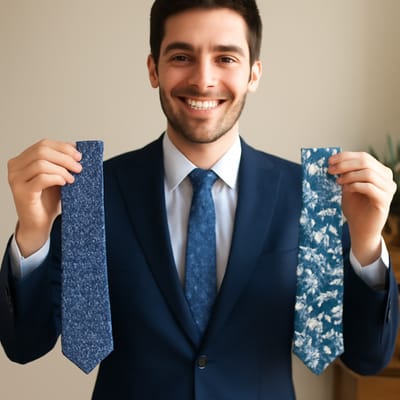
A common frustration with blue floral neckties is that they can feel “too busy,” especially when paired with textured suits or patterned shirts. Scale is your control knob for visual contrast.
Formality: small florals usually look dressier
Small floral patterns behave a bit like a micro-print. They keep the tie within the lane of classic menswear, particularly in navy or darker blues. Large florals can still be formal, but they skew toward expressive style—better for cocktail attire than strict business formal.
Contrast: the bigger the flower, the more the tie dominates
Ask yourself: do you want the tie to be a supporting detail or the headline?
- If you want a supporting detail, pick small floral with low-to-medium contrast (flowers close to the base blue).
- If you want a statement piece, pick large floral with high contrast (light flowers on deep blue, or bold multi-color blooms).
“Busyness” comes from scale + color count
Two ties can have the same number of flowers but look totally different if one uses 2 colors and the other uses 6.
Buying checkpoint: If the tie has large florals and 4+ colors, keep everything else calm: solid shirt, solid suit, minimal pocket square.
For specific shirt pattern do’s and don’ts (especially stripes and checks), Pairing Blue Floral Neckties with Shirts: Best Practices goes deeper into avoiding pattern clashes.
Outfit pairing rules: shirts, suits, and ties that don’t fight
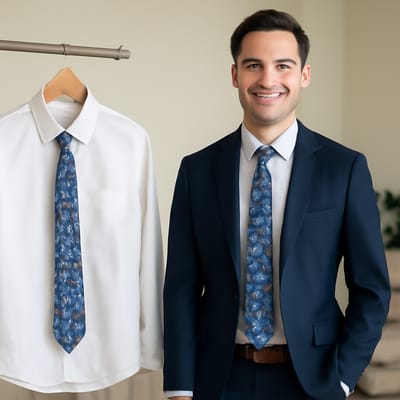
The goal is simple: make the floral tie look intentional. Use these pairing rules to solve the “I like it online, but it’s hard to wear” problem.
Shirt pairing (easy wins)
- White shirt: works with any blue floral scale; best for large florals.
- Light blue shirt: great with navy-based small florals; watch for too little contrast.
- Subtle stripe shirt: pair with small floral; keep stripe thin and low-contrast.
Suit pairing (where most mistakes happen)
- Navy suit: easiest with small floral; for large florals, ensure the flower color isn’t the same navy as the suit (you need separation).
- Charcoal or mid-gray suit: arguably the best canvas for both scales; makes blue pop without clashing.
- Tan or light beige suit: can look excellent with blue florals, but keep the floral colors warm-aware (avoid icy blues that look disconnected).
Pattern mixing: one pattern should be “dominant”
If you choose a large floral blue necktie, treat it as the dominant pattern and keep shirt and suit solid or near-solid. If you choose a small floral, you can mix a second subtle pattern (like a fine stripe shirt) as long as the pattern sizes are clearly different.
Practical shopping tip: choose your “repeat color”
Look for one color in the flowers you can repeat elsewhere (pocket square edge, socks, or a subtle boutonnière). Repeating one accent color makes even a bold large floral look coordinated rather than random.
Best For: weddings, planners, gifts, and menswear enthusiasts
If you’re picking floral scale for a specific job, use these quick “best for” callouts to reduce decision fatigue.
Best for wedding & event planners
- Small floral: ideal for groomsmen when you need cohesion across different body types and suit fits.
- Large floral: perfect for the groom or a featured guest when you want the tie to stand out in photos.
Best for gift buyers
If you’re unsure about the recipient’s style, small floral is the safest gift. Choose a blue base (navy is most versatile) with 2–3 flower colors. Large florals can be an amazing gift only if you know the person enjoys statement accessories.
Best for menswear enthusiasts
Large florals are a fun way to build outfits around a hero piece. Go for higher contrast, bolder blooms, and consider textured fabrics (like grenadine or slubby silk) to add depth—just keep the rest of the outfit controlled.
Best for gift shoppers (last-minute, low-risk)
Choose small floral with a classic width (around 3–3.25 inches) and a matte-to-semi-matte finish. It’s easier to wear across office, dinner, and event settings.
Lead magnet idea you can use immediately
If you’re planning multiple outfits (or buying for a group), create a simple checklist: base blue (navy/royal/dusty), floral scale (small/large), and one repeat accent color. That’s the backbone of a reliable color coordination plan.
Buying and care checklist: what makes a floral tie look expensive?
Floral ties can look premium or flimsy even at similar prices. These checks help you avoid the pain point of a tie that wrinkles, shines too much, or prints poorly.
Quality signals to look for when shopping
- Crisp print edges: Flowers should have clean outlines, not blurry borders.
- Good ground color depth: The blue base should look saturated, not washed out.
- Balanced fabric hand: Too stiff looks cheap; too floppy can knot poorly.
- Stitching and tipping: Neat stitching and aligned pattern at the seams suggest better finishing.
Fabric choice affects how scale reads
- Shiny fabrics make large florals look even louder.
- More matte textures make bold patterns feel more wearable.
Care basics that preserve shape and color
- Untie after each wear (don’t leave knots set overnight).
- Hang or roll loosely; avoid crushing the floral print.
- Spot-clean carefully; aggressive rubbing can distort printed color.
If you’re deciding between two ties and one is slightly pricier, pay extra for better print clarity and a fabric that knots cleanly—those are the things people notice up close.
Frequently Asked Questions
Is a small floral blue necktie more formal than a large floral?
Usually, yes. Small florals read like a micro-pattern and blend into classic tailoring more easily, especially in darker blues. Large florals can still work for formal events, but they feel more expressive.
What shirt is safest with a large floral blue necktie?
A solid white shirt is the safest option because it gives the tie clean visual space. If you want color, go light blue with clear contrast between the shirt and the tie’s base.
Can wedding & event planners use large florals for groomsmen ties?
They can, but it’s harder to keep the party looking cohesive. Large florals are better as a spotlight choice (groom or one role), while small florals keep a uniform look across different heights and builds.
What’s the best floral scale if I’m buying a tie as a gift?
Small floral is the safest gift because it’s versatile and less style-specific. Choose a navy base with a limited color palette so it pairs easily with common suits.
Are large floral ties “too much” for menswear enthusiasts?
Not at all—large florals are often the point. The key is to keep the shirt and suit simple and repeat one accent color from the flowers elsewhere to make the outfit look intentional.
I’m a last-minute gift shopper—what’s the lowest-risk option?
Pick a small floral blue necktie with medium contrast and a classic width. It works across office wear, dinners, and weddings without requiring the recipient to style around it.
How do I keep a floral tie from looking cheap?
Prioritize crisp print edges, a rich blue ground color, and a fabric that knots cleanly. Avoid overly shiny finishes if you’re worried about the pattern feeling loud or costume-like.